「察してほしい」国、日本
日本や中国、台湾、韓国。東アジアの国々には、共通する美しい精神性が宿っています。それは「察する」という文化です。
言葉を尽くさずとも相手の状況を読み取り、場の空気を調和させるよう振る舞う。これはいわゆる「ハイコンテクスト文化」と呼ばれるものですが、特に中国や韓国でもその傾向は強く、社会人としての素養にもなっています。
特にビジネスの場において、中国や韓国でもこの「察する」力は重宝されますが、その度合いを比較すると、中国・台湾から韓国、そして日本へと向かうにつれ、「言わなくても分かってほしい」という期待値が高まる傾向にあります。日本は、世界でも類を見ないほど「察しの文化」が深く根付いた国なのです。
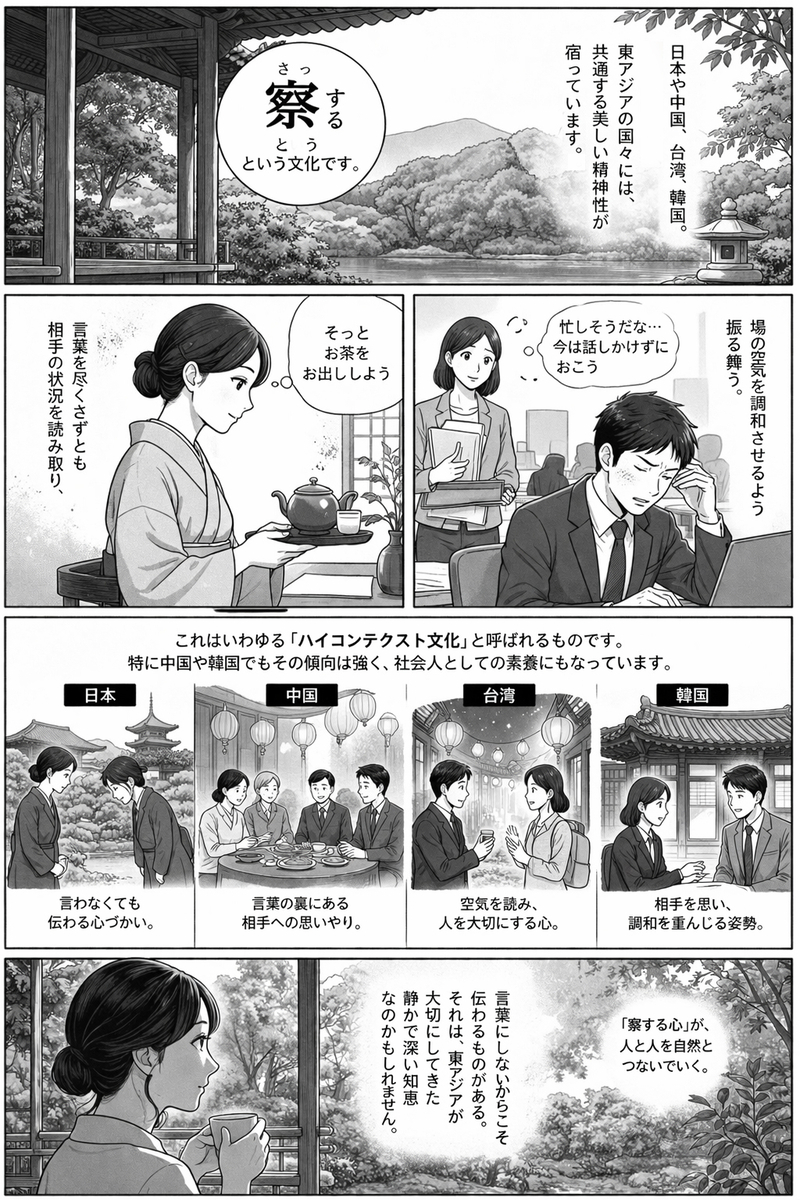
この「察しの文化」は、阿吽の呼吸を生む素晴らしい気遣いである一方で、時に私たちの行動に「遠慮」というブレーキをかけます。
「みんなが頑張っているから、自分だけ水を飲むのは失礼かもしれない」 「冷房が寒いけれど、言い出したら授業の邪魔になるかも」
そんな風に、誰かを想う優しさが、結果として自分を少しずつ窮屈にしてしまう。
レッスンという学びの場においても、この「見えないブレーキ」は時として、集中力や楽しさを削いでしまう原因になります。
対して、欧米などの「ローコンテクスト文化」では、言葉にしないことは存在しないことと同じ、という考え方が一般的です。
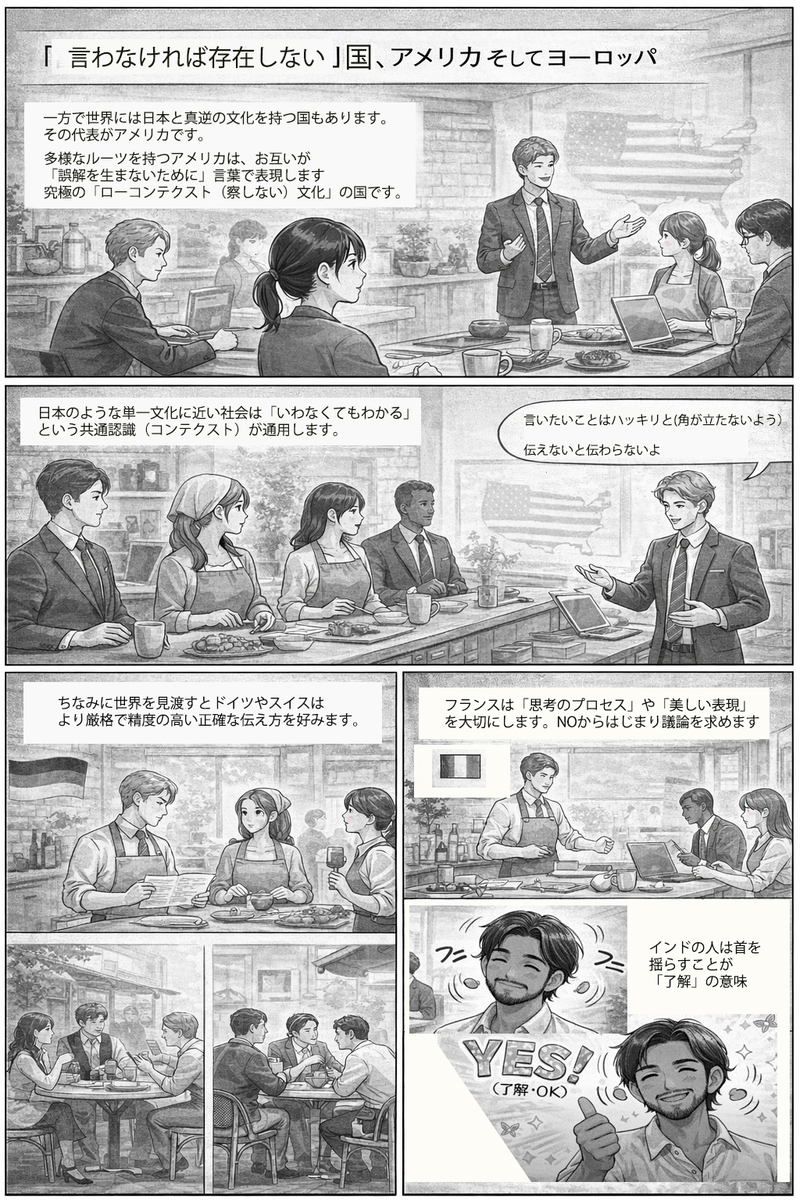
「言わなければ存在しない」国、アメリカそしてヨーロッパ
一方で、世界には真逆の文化を持つ国もあります。その代表がアメリカです。多種多様なルーツを持つ人々が集まるアメリカは、究極の「ローコンテクスト(察しない)文化」の国。
日本のような単一民族に近い社会では「言わなくてもわかる」という共通認識(コンテクスト)が通用します。しかし、アメリカは世界中から多様なルーツを持つ人々が集まった移民国家です。
バックグラウンドが全く異なる人同士が会話をする際、相手の空気を読んでいては、誤解だらけで社会が回りません。そのため、「言葉にしたことだけが真実であり、言わないことは存在しないのと同じ」というルールが徹底されました。
そこでは、「言葉にしないことは、存在しないのと同じ」と考えられます。「察してほしい」と黙っていることは、相手にとって「何も困っていない」と解釈されます。だからこそ、自分の状態をはっきりと言葉で伝えることが、相手に対する誠実さであり、自分を守る唯一の手段なのです。
-----------------------------------------
「言葉を尽くす国」アメリカそしてヨーロッパ
「言わなければ伝わらない」という文化は、一見するとシンプルで楽なように思えます。しかし実際には、言葉に頼り切るからこそ、相手を不快にさせないための高度なコミュニケーション技術が必要な国々でもあります。
例えば、アメリカやヨーロッパで自分の意見を伝えるとき、ただ「嫌だ」「こうして」と言うだけでは、トゲが立ってしまいます。そこで彼らが駆使するのが、以下のような技術です。
-
「I(アイ)メッセージ」で伝える 「あなたは冷房を下げすぎだ(You)」と相手を責めるのではなく、「私は少し寒く感じています(I)」と自分の状態を伝える。角を立てずに自分の希望を通す、洗練された技術です。
-
「結論」+「理由」のセット ただ「NO」と言うのではなく、「なぜなら〜だからです」という論理(ロジック)を添える。納得感を与えることが、相手への最大のリスペクトと考えられています。
-
ポジティブな言葉でサンドイッチする 「この料理は最高です!ただ、私には少し辛すぎるかもしれません。でも味付けは本当に素晴らしいですね」といったように、ネガティブな要望をポジティブな評価で挟むなど、言葉の組み立てに非常に気を遣います。
-----------------------------------------
ちなみに世界を見渡すと、ドイツやスイスなどはさらに厳格で、正確な言葉での定義を好みます。逆にフランスやイタリアなどのラテン諸国は、日本ほどではなくとも、少しだけ「空気」や「情熱」で通じ合う部分を持っています。
-----------------------------------------
世界の「察しない(ローコンテクスト)」ランキング
文化人類学などの研究に基づくと、一般的に以下のような順序で「言葉の明快さ」が求められます。
アメリカ > ドイツ > スイス > フランス
ドイツ・スイス: 「正確さ」を極限まで求めます。察する余地がないほど、緻密に言葉で定義することを好みます。
アメリカ: 「結論から言う」「イエスかノーか」を明確にすることを、相手に対する誠実さ(リスペクト)だと考えます。
フランス:コミュニケーションスタイルは、このランキングの中では非常にユニークで、「ハイコンテクスト(察する)」と「ローコンテクスト(はっきり言う)」のハイブリッド型と言えます。
アメリカ人やドイツ人から見れば「もっとはっきり言ってよ」と思われ、日本人から見れば「なんてズケズケ言うんだ」と思われる、独特の立ち位置にいます。フランス人の特徴をいくつか紐解いてみましょう。
-----------------------------------------
フランス人
1. 結論よりも「プロセス」を愛する
アメリカ人が「結論から先に」と言うのに対し、フランス人は結論に至るまでの**「思考のプロセス」や「美しい表現」を大切にします。議論そのものを楽しむ文化があるため、最後まで聞かないとイエスかノーか分からない、という「察し」に近い情緒が含まれることがあります。
2. 「言わぬが花」のエスプリ(機転)
フランス人は論理的ですが、同時に「野暮な説明を省く」という美学も持っています。相手と共有している教養や文化的な背景を前提に、あえて比喩やウィットに富んだ表現を使うことも。この「文脈を読み取る力」を求める点は、少し日本人に似ているかもしれません。
3. 「NO」は拒絶ではなく、対話の始まり
日本人が調和のために「NO」を避けるのに対し、フランス人はまず「Non(ノン)」から入ることがよくあります。これは拒絶ではなく、「ここから知的な議論を深めよう」という合図。はっきり主張することは、相手への攻撃ではなく、お互いを高め合うための「作法」なのです
------------------------------------------------------
どちらが正しいというわけではありません。ただ、こと「心身の健康」や「心地よさ」に関しては、もっと「言葉」に頼ってもいいのではないかと思うのです。
------------------------------------------------------
さて世界中の人たちが集まる講師は、レッスンの場を「誰かに合わせる場所」ではなく、「自分を最高な状態にする場所」であってほしいと願っています。
だから、生徒さんにはこう伝えています。 「ここでは、あなたの『快適さ』を一番に考えてください」と。
喉が渇いたら、隣の誰かを気にせず水を飲む。
疲れたら、遠慮なく椅子に腰を下ろす。
暑い、寒いをわがままではなく「大切な情報」として講師に伝える。
保冷剤を持ってきたなら、冷凍庫を「借りるのが申し訳ない」と溶かすのではなく、キンキンに冷えた状態で活用する。
こうした一つ一つの「自己主張」は、決してわがままではありません。自分のコンディションを自分で整えることは、より深く学び、より豊かな時間を過ごすための、前向きな参加表明なのです。
「察してほしい」という奥ゆかしさは、外の世界では美徳かもしれません。でも、私たちのクラスにいる間だけは、その荷物を一度下ろしてみてください。
あなたの「快適」が、クラス全体の良い空気を作ります。 「言ってくれなきゃ、わからない」からこそ、あなたの言葉を、私はいつでも待っています。
📢 レッスンを楽しく受けていただくためのお願い
皆さまが心地よくレッスンに集中できるよう、いくつかお伝えしたいことがあります。 「こんなこと言ってもいいのかな?」という遠慮は、ここでは必要ありません!
💧 水分補給について
講師側でもお飲み物を準備しておりますが、数に限りがございます。
🪑 休憩について
レッスンのペースは人それぞれです。
🌡️ 空調(冷房)について
冷房の設定には気をつけておりますが、体感温度は着ている服や体質によって一人ひとり異なります。
❄️ 保冷剤の活用について
お持ち帰り時の安全対策として保冷剤をお持ちいただくのは大歓迎です!
💡 講師からのメッセージ
日本人は特に「周りに合わせなきゃ」と自分を後回しにしがちですが、このクラスでは**「自分の快適さ」を一番に考えてOK**です。
皆さんの「快適」が、良いレッスンを作ります。気になることがあれば、いつでも言葉にして教えてくださいね!
Japan: The Land of "Anticipating Needs"
In East Asian countries like Japan, China, Taiwan, and South Korea, there is a beautiful shared cultural value: the art of "Sassuru" (anticipating others' needs or reading between the lines).
This means understanding someone’s situation and acting to maintain harmony without needing words. In social science, this is known as a "High-Context Culture." This tendency is particularly strong in Chinese and Korean professional societies, where it is considered an essential social skill.
However, when comparing the intensity of this trait, there is a spectrum: from China and Taiwan, to South Korea, and finally to Japan. As you move toward Japan, the expectation that "others should understand me without me saying a word" becomes increasingly high. Japan is truly a country where the culture of "silent understanding" is more deeply rooted than anywhere else in the world.
While this culture creates a beautiful "unspoken harmony," it can also act as a brake on our actions, often manifesting as "Enryo" (restraint or hesitation).
-
"Everyone is working hard, so it might be rude if I'm the only one drinking water."
-
"The air conditioning is cold, but if I speak up, I might interrupt the lesson."
In this way, the kindness we show others can unintentionally make us feel restricted. In a learning environment like a cooking lesson, this "invisible brake" can sometimes diminish your concentration and enjoyment.
In contrast, Western "Low-Context Cultures" operate on a different principle: if something is not put into words, it effectively does not exist.
The United States: The Land of "If You Don't Say It, It Doesn't Exist"
On the opposite end of the spectrum is the United States, the ultimate "Low-Context Culture." As a nation of immigrants with diverse backgrounds, Americans cannot rely on a shared unspoken understanding.
If people from completely different backgrounds tried to "read the air," society would be filled with misunderstandings. Therefore, the rule is simple: "Only what is spoken is true; what remains unsaid is not recognized."
In this culture, silence is interpreted as "everything is fine." Speaking your mind clearly is not seen as selfish; rather, it is viewed as an act of honesty and a way to protect your own well-being.
Looking globally, other countries have their own styles:
-
Germany & Switzerland: Demand extreme "precision." They prefer everything to be defined with meticulous detail, leaving no room for guessing.
-
The United States: Values "getting straight to the point" and clear "Yes/No" answers as a form of respect for the other person's time.
-
Latin Cultures (France, Italy, etc.): While more verbal than Japan, they still value a bit of "ambiance" and "passion" to communicate what lies between the words.
Your "Comfort" Creates a Great Class
Neither culture is "right" or "wrong." However, when it comes to your well-being and comfort, we believe it is better to lean on "words."
Our instructors—who come from all over the world and include embassy staff, diplomats, and spouses of global executives—want this classroom to be a place where you strive for your best self, rather than a place where you simply "blend in" with others.
That is why we tell our students: "In this room, please put your own comfort first."
-
Drink water when you are thirsty, without worrying about those around you.
-
Take a seat and rest whenever you feel tired.
-
Tell the instructor if you are hot or cold; this is "valuable information," not a "selfish complaint."
-
If you brought ice packs, put them in the freezer. Don't let them melt out of a sense of "not wanting to bother us." Use them to stay refreshed!
Expressing your needs is not being selfish. Taking care of your own condition is a proactive way to participate, ensuring you can learn more deeply and enjoy a richer experience.
While the modesty of "wanting to be understood without words" is a virtue in the outside world, please leave that luggage at the door when you enter our class.
Your "comfort" creates a positive atmosphere for the entire group. Because "we won't know unless you tell us," I am always waiting for your words.
📢 Requests for an Enjoyable Lesson
To help everyone focus comfortably, please remember that there is no need for "Enryo" (hesitation) here!
💧 Hydration We have some drinks available, but supply is limited.
🪑 Resting Everyone learns at their own pace.
🌡️ Air Conditioning Body temperatures vary from person to person.
❄️ Ice Packs We welcome you to bring ice packs to keep your food safe for the journey home!
💡 A Message from the Instructor In this class, it is perfectly okay to put your own comfort first. Your well-being makes the lesson better for everyone. If anything is on your mind, please put it into words and let us know!
这是一篇非常深刻且充满关怀的文字。为了能让来自不同文化背景的学生(尤其是习惯于“察言观色”的亚洲学生)感到轻松和被尊重,我将其翻译成了自然、亲切且具有文学色彩的中文。
日本:一个“渴望被察觉”的国家
在日本、中国、台湾和韩国等东亚国家和地区,存在着一种共同而美丽的独特精神。那就是**“察(Sassuru)”**的文化。
即便不把话说明白,也能通过解读对方的处境,来调整自己的行为以维持场面和谐。这在社会学上被称为**“高语境文化(High-Context Culture)”**。在中国和韩国,这种倾向也非常强烈,甚至被视为职场人士必备的素养。
然而,如果对比这种“察觉”的密度,通常认为存在这样的趋势:中国/台湾 < 韩国 < 日本。随着向日本靠近,“希望对方即便我不说也能明白”的期待感就越高。日本可以说是世界上将“察的文化”扎根最深的国家。
这种文化在产生“心领神会”的默契与关怀的同时,有时也会给我们的行动套上名为**“顾虑(Enryo)”**的枷锁。
这种对他人的温柔体贴,结果却让自己陷入了局促。在烹饪课这种学习场所,这种“无形的枷锁”有时会成为消减专注力和乐趣的原因。
与之相对,欧美等**“低语境文化(Low-Context Culture)”**则普遍认为:没有说出口的话,就等同于不存在。
美国:一个“不说出来就不存在”的国家
世界另一端存在着截然相反的文化,其代表便是美国。美国是一个由拥有多种文化背景的人们组成的移民国家,是极致的“低语境(不靠察觉)”文化国家。
由于大家的背景完全不同,如果靠“读空气”来交流,社会将充满误解。因此,他们恪守一条准则:“只有说出口的话才是真实的,不说出来就等同于不存在。”
在这种文化中,保持沉默会被理解为“一切都很好”。清晰地表达自己的状态,并不是自私,而是一种“诚实”,也是保护自己的唯一手段。
纵观世界,各国对“语言明晰度”的要求大致如下:
美国 > 德国 > 瑞士 > 法国
-
德国、瑞士: 追求极致的“准确”,喜欢用严密的语言进行定义,不给“察觉”留任何余地。
-
美国: 认为“先说结论”、“明确Yes或No”是对他人最基本的尊重。
-
法国、意大利: 虽然不如日本,但仍保留了一部分通过“氛围”或“热情”来沟通的空间。
您的“舒适”是成就优秀课堂的关键
这两种文化并没有优劣之分。只是,在涉及**“身心健康”和“舒适感”**时,我认为我们可以更多地依赖“语言”。
我们的老师来自世界各地(包括大使馆官员、外交官和CEO夫人等),他们希望教室不是一个“迎合他人的地方”,而是一个**“让自己处于最佳状态的地方”**。
所以,我们会这样告诉学生: “在这里,请把您的‘舒适’放在第一位。”
这些小小的“自我主张”绝非自私。调节好自己的状态,是为了更深入地学习、度过更充实时光的一种积极参与的表现。
“渴望被察觉”的含蓄在外界也许是美德,但在我们的课堂里,请试着放下这个心理负担。
您的“舒适”会带动整个课堂的好氛围。正因为**“不说明白,我们就无法理解”**,所以,我随时倾听您的声音。
📢 为了让您享受课程的小建议
为了让大家能舒适地专注于学习,有几点需要和大家沟通。在这里,完全不需要有“说这种话合不合适”的顾虑!
💧 关于水分补充 虽然教室会准备饮品,但数量有限。
🌡️ 关于空调(冷气) 每个人的体感温度不同。
❄️ 关于保冷剂的使用 为了带回食物的安全,非常欢迎大家自带保冷剂!
🪑 关于休息 每个人的节奏都不同。
💡 来自老师的信息 在这个课堂上,把“自己的舒适”放在首位是完全没问题的。大家的舒适感会造就更好的课程质量。如果有任何在意的事情,请随时用言语告诉我们!
Japón: El país del "entender sin palabras"
En los países de Asia Oriental, como Japón, China, Taiwán y Corea del Sur, existe una hermosa filosofía compartida: el arte del "Sassuru" (anticipar las necesidades del otro o leer entre líneas).
Se trata de comprender la situación de alguien y actuar para mantener la armonía sin necesidad de usar palabras. En sociología, esto se conoce como una "Cultura de Alto Contexto". Esta tendencia es muy fuerte en las sociedades profesionales de China y Corea, donde se considera una habilidad social esencial.
Sin embargo, al comparar la intensidad de este rasgo, existe un espectro: desde China y Taiwán, pasando por Corea del Sur, hasta llegar a Japón. A medida que nos acercamos a Japón, la expectativa de que "los demás deben entenderme sin que yo diga una palabra" es cada vez más alta. Japón es, verdaderamente, el país donde la cultura del entendimiento silencioso está más profundamente arraigada.
Si bien esta cultura crea una hermosa "armonía tácita", también puede actuar como un freno en nuestras acciones, manifestándose como "Enryo" (reserva o vacilación).
-
"Todos están trabajando duro, así que sería de mala educación si soy el único que bebe agua".
-
"El aire acondicionado está frío, pero si lo digo, podría interrumpir la lección".
De esta manera, la amabilidad que mostramos hacia los demás puede hacernos sentir restringidos sin quererlo. En un entorno de aprendizaje como una clase de cocina, este "freno invisible" a veces puede disminuir la concentración y el disfrute.
En contraste, las "Culturas de Bajo Contexto", como las occidentales, operan bajo un principio diferente: si algo no se expresa con palabras, es como si no existiera.
Estados Unidos: "Si no se dice, no existe"
En el extremo opuesto del espectro se encuentra Estados Unidos, el ejemplo máximo de una cultura de bajo contexto. Al ser una nación de inmigrantes con diversos orígenes, los estadounidenses no pueden confiar en un entendimiento tácito compartido.
Si personas de orígenes completamente diferentes intentaran "leer el aire", la sociedad estaría llena de malentendidos. Por lo tanto, la regla es simple: "Solo lo que se habla es real; lo que no se dice, no se reconoce".
En esta cultura, el silencio se interpreta como "todo está bien". Expresar lo que uno piensa con claridad no se ve como algo egoísta; más bien, se ve como un acto de honestidad y una forma de proteger el bienestar propio.
Mirando globalmente, otros países tienen sus propios estilos:
-
Alemania y Suiza: Exigen una "precisión" extrema. Prefieren que todo se defina con detalles meticulosos, sin dejar lugar a suposiciones.
-
Estados Unidos: Valora ir "directo al grano" y las respuestas claras (Sí/No) como una forma de respeto hacia el tiempo del otro.
-
Culturas Latinas (Francia, Italia, España, Latinoamérica): Aunque son más verbales que Japón, todavía valoran un poco la "ambigüedad" y la pasión para comunicar lo que hay entre las palabras.
Tu "comodidad" crea una clase excelente
Ninguna cultura es mejor que otra. Sin embargo, cuando se trata de tu bienestar y comodidad, creemos que es mejor apoyarse en las "palabras".
Nuestros instructores —que vienen de todo el mundo e incluyen personal de embajadas, diplomáticos y esposas de ejecutivos globales— desean que esta clase sea un lugar para buscar tu mejor versión, y no simplemente un lugar para "encajar" con los demás.
Por eso les decimos a nuestros alumnos: "En esta sala, por favor, pon tu propia comodidad en primer lugar".
-
Bebe agua cuando tengas sed, sin preocuparte por quienes te rodean.
-
Toma asiento y descansa cuando te sientas cansado.
-
Dile al instructor si tienes calor o frío; esto es "información valiosa", no una queja.
-
Si trajiste acumuladores de frío (gel), ponlos en el congelador. No dejes que se derritan por "no querer molestar". ¡Úsalos para mantener tus alimentos frescos!
Expresar tus necesidades no es ser egoísta. Cuidar tu propio estado es una forma proactiva de participar, asegurando que puedas aprender profundamente y disfrutar de una experiencia más rica.
Aunque la modestia de "querer ser entendido sin palabras" es una virtud fuera de aquí, por favor, deja ese equipaje en la puerta cuando entres a nuestra clase.
Tu "comodidad" crea una atmósfera positiva para todo el grupo. Debido a que "no lo sabremos a menos que nos lo digas", siempre estaré esperando tus palabras.
📢 Recomendaciones para una clase agradable
Para ayudar a que todos se concentren cómodamente, recuerda que aquí no hay necesidad de tener "Enryo" (vacilación).
💧 Hidratación Tenemos algunas bebidas disponibles, pero el suministro es limitado.
🪑 Descanso Cada persona aprende a su propio ritmo.
🌡️ Aire acondicionado La temperatura corporal varía de persona a persona.
❄️ Acumuladores de frío (保冷剤) ¡Te animamos a traer acumuladores de frío para mantener tus alimentos seguros de camino a casa!
💡 Mensaje del instructor En esta clase, está perfectamente bien poner tu propia comodidad primero. Tu bienestar hace que la lección sea mejor para todos. Si tienes algo en mente, ¡ponlo en palabras y dínoslo!
Le Japon : le pays où l'on « devine » les besoins
Au Japon, comme en Chine, à Taïwan ou en Corée du Sud, il existe une valeur spirituelle commune et magnifique : l'art de « Sassuru » (anticiper les besoins d'autrui ou lire entre les lignes).
Cela consiste à comprendre la situation de l'autre et à agir pour maintenir l'harmonie sans avoir besoin de mots. En sociologie, on appelle cela une « culture de haut contexte ». Cette tendance est très forte dans les milieux professionnels chinois et coréens, où elle est considérée comme une compétence sociale essentielle.
Cependant, si l'on compare l'intensité de ce trait, il existe une gradation : de la Chine et Taïwan vers la Corée, puis enfin vers le Japon. Plus on se rapproche du Japon, plus l'attente que « l'autre comprenne sans que j'aie à parler » est élevée. Le Japon est véritablement le pays où cette culture de la compréhension silencieuse est la plus profondément ancrée.
Si cette culture crée une belle harmonie tacite, elle peut aussi agir comme un frein à nos actions, se manifestant par l'« Enryo » (la réserve ou l'hésitation).
-
« Tout le monde travaille dur, ce serait peut-être impoli si je suis le seul à boire de l'eau. »
-
« La climatisation est trop froide, mais si je le dis, je vais peut-être interrompre la leçon. »
Ainsi, la gentillesse que nous portons aux autres peut nous rendre, malgré nous, un peu plus contraints. Dans un lieu d'apprentissage comme un cours de cuisine, ce « frein invisible » peut parfois nuire à la concentration et au plaisir.
À l'inverse, dans les « cultures de bas contexte » (comme en Occident), ce qui n'est pas exprimé par des mots est souvent considéré comme n'existant pas.
Les États-Unis : « Si on ne le dit pas, cela n'existe pas »
À l'autre extrémité du spectre se trouvent les États-Unis, l'exemple ultime de la culture de bas contexte. En tant que nation d'immigrants aux origines diverses, les Américains ne peuvent pas se reposer sur une compréhension tacite partagée.
Si des personnes d'horizons totalement différents essayaient de « lire l'air », la société serait pleine de malentendus. Par conséquent, la règle est simple : « Seul ce qui est dit est vrai ; ce qui n'est pas dit n'est pas reconnu. »
Dans cette culture, le silence est interprété comme « tout va bien ». Exprimer ses besoins clairement n'est pas perçu comme de l'égoïsme, mais comme une forme d'honnêteté et un moyen de protéger son propre bien-être.
À l'échelle mondiale, chaque pays a son propre style :
-
L'Allemagne et la Suisse : Exigent une précision extrême. On préfère que tout soit défini méticuleusement, sans laisser de place aux suppositions.
-
Les États-Unis : Valorisent le fait d'aller « droit au but » comme une forme de respect pour l'autre.
-
Les pays latins (France, Italie, etc.) : Bien qu'ils soient plus verbaux que le Japon, ils apprécient encore un peu l'ambiance et l'implicite pour communiquer ce qui se trouve entre les mots.
Votre « confort » crée un excellent cours
Aucune culture n'est supérieure à l'autre. Cependant, lorsqu'il s'agit de votre bien-être et de votre confort, nous pensons qu'il est préférable de s'appuyer sur les « mots ».
Nos professeurs — qui viennent du monde entier et incluent des diplomates ou des membres d'ambassades — souhaitent que ce cours soit un lieu pour être au mieux de vous-même, et non simplement un lieu pour vous « adapter » aux autres.
C'est pourquoi nous disons à nos élèves : « Ici, faites de votre confort votre priorité absolue. »
-
Buvez de l'eau quand vous avez soif, sans vous soucier des autres.
-
Asseyez-vous et reposez-vous dès que vous vous sentez fatigué.
-
Dites au professeur si vous avez trop chaud ou trop froid ; c'est une « information précieuse », pas une plainte.
-
Si vous avez apporté des pains de glace, mettez-les au congélateur. Ne les laissez pas fondre par peur de « déranger ». Utilisez-les pour rester frais !
Exprimer ses besoins n'est pas de l'égoïsme. Prendre soin de son propre état est une manière proactive de participer, garantissant un apprentissage plus profond et une expérience plus riche.
Si la modestie du « vouloir être compris sans mots » est une vertu à l'extérieur, laissez ce bagage à la porte en entrant dans notre classe. Votre confort crée une atmosphère positive pour tout le groupe. Parce que « si vous ne le dites pas, nous ne pouvons pas le savoir », j'attends vos mots avec impatience.
📢 Recommandations pour un cours agréable
Pour que chacun puisse se concentrer confortablement, n'oubliez pas qu'il n'y a pas besoin d'« Enryo » (hésitation) ici !
💧 Hydratation Nous avons quelques boissons, mais les stocks sont limités.
🌡️ Climatisation La température corporelle varie d'une personne à l'autre.
❄️ Pains de glace (accumulateurs de froid) Nous vous encourageons à apporter des pains de glace pour transporter vos plats en toute sécurité !
🪑 Repos Chacun apprend à son propre rythme.
💡 Message du professeur Dans ce cours, il est tout à fait normal de faire passer votre confort en premier. Votre bien-être améliore la leçon pour tout le monde. Si vous avez quoi que ce soit à l'esprit, exprimez-le par des mots !